0

Tag: writing process

Deb writing in various locales

How Long Does It Take To Write A Book (Part 2: Planning It)

Okay, it’s kinda strange for Part 2 of this post to be about the planning writing a book after having covered the actual sit-down writing process in Part 1. The reason is that you can easily spend all your time planning and never get to the stage of actual writing and the actual writing stage is essential… so I gave it to you first. But yes, you have to plan a book before writing it.

The planning and research stage is much more nebulous and open-ended.

For nonfiction, you draft out a detailed table of contents – basically the outline and core of the book, you conduct research including reaching out to and interviewing subject matter experts, you write a couple of sample chapters to test out style and approach, you research other books on the market to see if what you’re writing is indeed original and marketable, and you research publishers (including self-publishing options) to find the right fit.

Here’s an overview of the time it took for the planning/research stage of the third edition of “Film Production Management 101”:

  • Winter/Spring 2023 – Research & planning, including revised Table of Contents, meeting Subject Matter Experts, researching the market.
  • Summer 2023 – Proposal to publisher for revised edition. Marking up the existing edition (optimistically getting ready for the writing stage). Continue Subject Matter Expert meetings.
  • Fall 2023 – Acceptance of proposal by publisher. Hands-on-keyboard writing stage of the whole book.
  • Winter 2024 – One month off break to reset the mind, then hands-on-keyboard writing of the final draft.
  • Spring 2024 – Delivery to publisher
  • Summer 2024 – Copyediting with the publisher
  • Christmas 2024 – First preview copy of published book
  • Winter 2025 – Publication of third edition of “Film Production Management 101”

… which is why when someone is asked how long it takes to write a book, they often say a year or more.

It’s also worthy of note (during the planning stage) that considering how long it takes to research, plan, write, rewrite and publish a book, it’s hugely important that the contents of the book will last. The material I started assembling back in winter/spring of 2023 needed to be topical as of publication in 2025 and needs to be relevant for many years to come.

I hope this post inspires and motivates you on your own writing journey in 2026. Best wishes to you in this new year of possibilities!

Cheers & a good writing session to you,
Deb

P.S. If you missed the “writing it” Part 1 post, here ‘tis:
https://www.debpatz.com/how-long-does-it-take-to-write-a-book-part-1-writing-it/

=====================

Film Production Management 101” (now in its third edition) is updated for today’s respectful workplace and sustainable practices – available worldwide, including Amazon-USA, Indigo-Canada and many other bookstores or directly from the publisher (MWP).

Write! Shoot! Edit!” (written for young adults) is a choose-your-own-path book where you can follow the path of the writer, director-DP or editor to make your first films. It’s also available worldwide, including Amazon-USA, Indigo-Canada (Kobo), or directly from the publisher (MWP).
Deb and her writing thermometer

How Long Does It Take To Write A Book (Part 1: Writing It)

New Years brings to mind the setting of resolutions and taking steps toward fulfilling a life goal or two. Is writing a book one of those life goals you have? Many of us have a book (or many) in us itching to get out.

Having written a few books now myself, and with “Film Production Management 101” weighing in at over 500 pages, I’m frequently asked the question of how long it takes to write a book – especially while working full time. Well, let me tell you. My process is for a nonfiction book, but the approach and discipline can be adapted to any book or script.

Firstly, know that there is a whole stage of preparing to write the book, but I won’t go into the planning in this post. What we’re interested in is the actual sit-down and writing stage. I’ll cover planning in a Part-2 post.

So, planning is done. The table of contents (the outline) is set and you know what you’re going to cover in each chapter. In the case of “Film Production Management 101,” the table of contents already existed but was being modified for the third edition, as the new edition was undergoing a comprehensive rewrite from page 1.

I need both discipline and flexibility in the writing process. Although, once I start the fingers-to-keyboard writing phase, I need to keep pushing forward on a near daily basis. Some chapters are easier and faster to write than others, so getting bogged down in a one chapter for multiple days can be sobering if I don’t celebrate the days where I speed along.

For the initial edition, I pushed to average one chapter per writing day. I built in contingency days for family obligations and for the expectation that some chapters would take longer than 1 day (which several did). When I stopped midway on a hard chapter (at the end of a writing session), I’d spend the time before the next scheduled session mulling over the writing challenge that stopped me. Even if I didn’t think I’d solved whatever it was, I pushed forward anyway knowing I’d come back and rewrite this section at a future date. Overall, the plan was to write 22 chapters in 22 + 7 days (over 5 weeks) and in actuality, it took 7 weeks.

For the revised edition, I had a marked-up book to work from as inspiration for the rewrite. Some chapters needed less updating than others, so I’d push to rewrite multiple chapters a day based on how well the writing flow was, well, flowing. Those fast-flowing days helped me feel accomplished even when I got bogged down in a chapter challenging to craft. The writing days were a little less than for the initial edition (20 days for 35 chapters), but balancing work-life and writing stretched the overall writing period from the hoped-for 6 weeks to 12.

How, then, to celebrate and self-motivate? I make a visual tracker.

For the initial edition, I used a calendar and declared which writing day would be for which chapter. It made writing a whole book tangible, achievable. At the end of each writing session, I recorded the actual chapter / chapters / part-chapter that I did complete. As mentioned, I did miss the overall schedule by two weeks but that was negligible when you look at the whole work. The contingency days were critical for writing catch-up and to address family obligations. Mid-writing, I had the opportunity to re-plan how many writing sessions per chapter (rather than how many chapters per writing session), but the push to keep up the pace was working to motivate me so I kept the original schedule as-is and delivered to myself a little late.

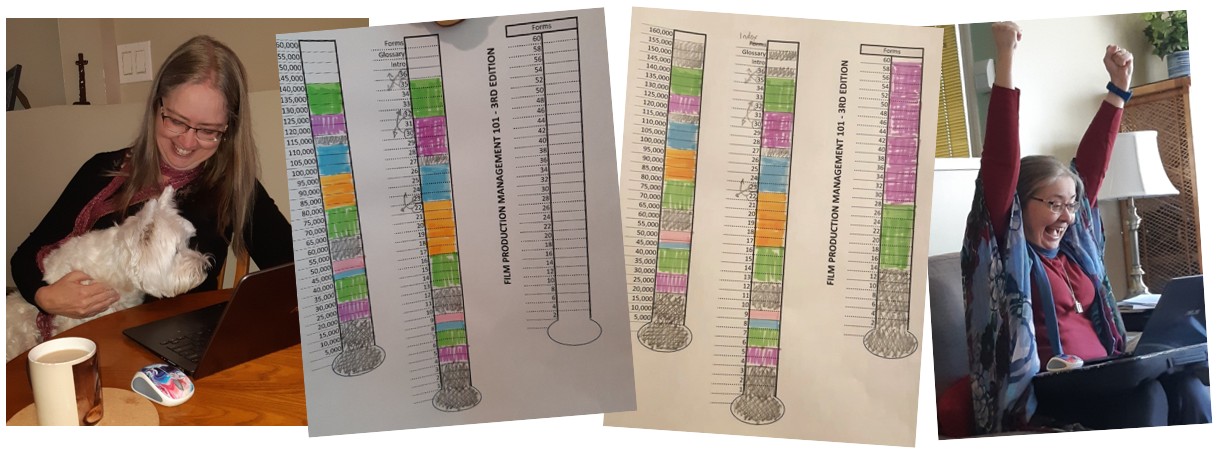
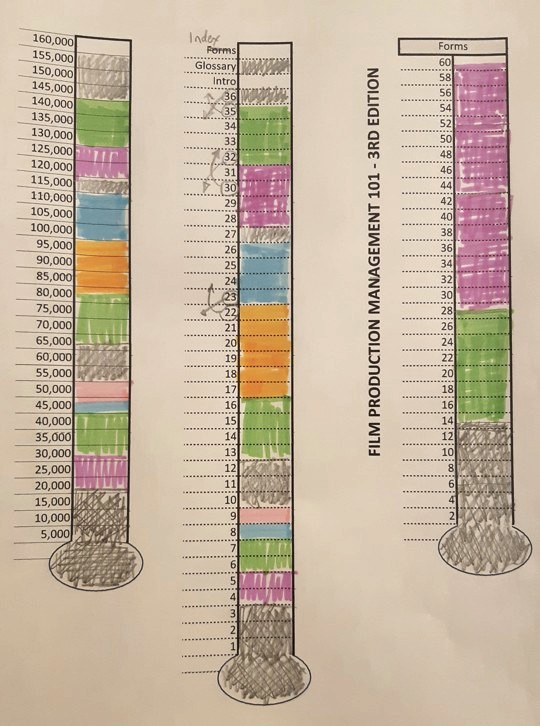
For the revised edition, I added colour to my tracker and turned it into a thermometer. I didn’t worry so much about meeting the minimum one chapter per day – the initial writing was already done (which takes longer) – so I used a writing thermometer which I posted on the fridge and I tracked both number of words and number of chapters I wrote in a day’s sitting. Because chapters varied in length, some days my word count was high, and other days my chapter count was high. I loved the messiness of random colours to keep my mind in a creative mindset. Here’s the completed thermometer tracker… where you’ll also see that I didn’t always write the chapters in order:

Thermometer writing schedule

Another nugget: I wrote the book at least twice each time. After the first pass writing the book (7 weeks for the initial edition, 12 weeks for the revised edition), I took a scheduled month off to let my mind reset enabling me to approach the book with fresh eyes. After the break, I leapt back in for a second pass rewrite. In the rewrite phase, I worked on concepts like accuracy, consistency of style, and overarching approach to the book. This phase of writing was much faster than the initial creation. I used a tracker for this phase too.

But as much as I love the writing – especially those magical easy-flow days – fitting in to a busy life is really, truly hard. The first time I wrote “Film Production Management” (which was called “Surviving Production” back then), I was single and working freelance – it was hard to write and hard fit into my life. When I wrote a later edition, I was married and had a dog and was working full time – and it was hard to write and hard fit into my life. When I wrote this latest edition, I was (still) married, had two dogs, a kid and an aging mother in the house – and it was hard to write and hard to fit into my life. But each time, I discovered: it was possible. Need outweighs the obstacles.

I hope this post gives you insight and inspiration for your own writing goals for 2026. Here’s to the new year and all its possibilities!

Cheers & a good writing session to you,
Deb

=====================

Film Production Management 101” (now in its third edition) is updated for today’s respectful workplace and sustainable practices – available worldwide, including Amazon-USA, Indigo-Canada and many other bookstores or directly from the publisher (MWP).

Write! Shoot! Edit!” (written for young adults) is a choose-your-own-path book where you can follow the path of the writer, director-DP or editor to make your first films. It’s also available worldwide, including Amazon-USA, Indigo-Canada (Kobo), or directly from the publisher (MWP).

Where and Where and Where I Write

Sure, I dream of a dedicated writing room with rows of books on shelves around the walls, a comfy chair with lamp and side table, a large surface area desk with ergonomic chair for my computer… and yeah, a dog bed nearby for a napping dog buddy.

But then reality creeps in.

I work as well as write, I have an active family – some who need shuttling around town – and the dog, well, she’d rather I sit on a couch with her a blanket than be at a desk. Instead, I have to find places to write amid my life and movements.

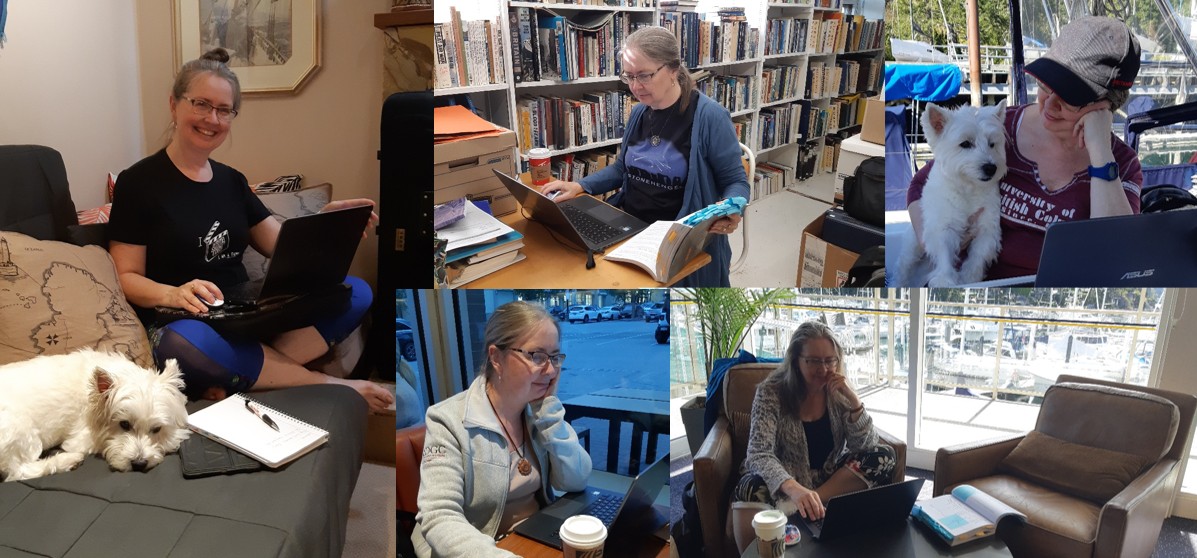
Consequently, here are some places I’ve written my books:

  • Coffee shop at 5 am opening time (yeah, classic, but nice and quiet)
  • Backstage at a theatre (using two chairs facing each other to better prop up my computer)
  • In the back room of a museum (don’t ask – I look pretty happy in the picture though!)
  • Desk at home (amid the clutter and noise of family)
  • Coffee shop at closing time (naturally)
  • Couch at home (yeah, I pandered to the dog for this one – call me weak)
  • College hallway lounge (surprisingly comfortable chairs and good plug-ins)
  • Airline seat (which movies make look a lot more comfortable than reality)
  • Hotel room (superbly quiet and free of distractions)
  • A boat at anchor (yeah, totally romantic, but the sunlight is blinding, the table is at a poor height for ergonomics and well, no power, so you’re on a time limit)

Do I have a favourite? Not really. I suppose I enjoy the variety – even if it’s because I have to enjoy it. What I need, however, is a dedicated amount of time to focus at any given session. The minimum time? Probably one hour for the most effective writing session, but I know I’ve written with less.

Life doesn’t stop to allow time to write. You just have to carve it out where and whenever there’s an opportunity. With the third edition of my “Film Production Management” book coming out in January (and its completion moment on the living room couch where the dog abandoned me for the floor, oh well), I’d say I found the time and the many, many places to write. You can too.

Cheers & a good writing session to you,
Deb

– – – – – – – – –

Where is Deb?

Mon. Oct. 14 – Raindance’s Boozin’ n Schmoozin’ Networking for Independent Filmmakers, London UK

FYI, the third edition of “Film Production Management 101” is coming to bookstores and online in January 2025, but available now for pre-order (e.g. on AmazonAmazon CanadaIndigo-Chapters).

Script page hanging from washing line

Laundry Writing

Script page hanging from washing lineI not talking about dirty laundry… okay, I kinda am.

Think you don’t have time to write? Well, if you can fit laundry into your schedule, then you have at least some time!

Scenario 1: The Laundromat.
Heave your loads to the laundromat. Dump the dirty garments into a row of machines and get them started. Now pull out your journal and pen (or open up your computer) and off you go! Write away the waiting time until it’s time for the transfer to dryers. That’s a good 30 minutes of timed writing! Use it as a warm up if you must and plan what to do when your laundry is in the dryers – because the drying cycle is longer; you’ll have at least an hour of focussed writing time. Cool, eh?

Okay, then there is…

Scenario 2: Laundry at Home.
Even better. You don’t have rows of machines to do all your laundry at the same time. Load #1 into the washer gets you 30 minutes of timed writing… the “Laundry Writing Warm-up.” The bell on the washer tells you it’s time for the transfer to dryer. Load #2 into the washer at the same time. Now you’ve got a good hour of focussed writing time. The washer’s bell is a mere warning sound; it’s the dryer’s alert that tells you it’s time for the transfer/re-load break. To delay folding until the end of your writing session, lay out the clothes loosely on the bed to minimize wrinkling… the deal is to get back to your writing as quickly as possible. Use the laundry to schedule writing sessions.

So there you go! I’ve just gifted you some time for writing that screenplay or novel, short story or poem that you’re itching to write. Celebrate the time you have – the time you can carve out your busy life – and use it well.

Cheers & happy laundry-writing to you,
Deb

– – – – – – – – – –

Deborah (Deb) Patz is the author of Write! Shoot! Edit! for teens and Film Production Management 101 for the industry – both books are published worldwide by MWP. She’s also part of the editorial board for Prism International. She’s kinda looking forward to piles of dirty laundry now… how odd is that?!

WHERE IS DEB? (upcoming events and appearances)
July 2019 – UFVA Conference, Minneapolis, MN

WHERE TO FIND DEB’S BOOKS?
Paperback or eBook: Amazon, Barnes & Noble, Chapters/Indigo, Waterstones, direct from the publisher and from plenty of other great bookstores worldwide.

Diving Into The Three Wells at Tea & Ink Writing Club

I was requested to mentor again at the Tea & Ink Writing Club and happily agreed. To do something a little different, this time I brought Matthew Kalil’s book The Three Wells of Screenwriting (a wonderful new MWP book on my bookshelf). It’s a book to get the inspiration juices flowing.

From the book, I introduced the group to Matthew’s three wells of creativity, and then we ran through the exercises to dive in and explore each one. Let me share a bit with you:

#1 – The External Sources Well –
The ideas and thoughts here are from external sources, like movies and books, etc. and from the writing exercises we noticed they were primarily visual. Tapping into this well was by far the fastest. Thoughts and ideas related to this well we found were very close to the surface and easily accessible.

#2 – The Imagination Well –
Wild and crazy ideas happened here. Some in space, some not. Wonder and personal philosophy inspired the ideas from this well, but it did take more focused thought to push past the external sources well to reach this well of uncharted imaginative ideas.

#3 – The Memory Well –
Finally, this well was the deepest and most personal. It triggered tender and teary emotions as well as memory of smells. No doubt it is from this well that we write most closely to the human experience, and it was clear that we required more thoughtful time than the previous two wells in order to access these memories honestly.

Gosh, we only tapped the start of Matthew’s book. He also highlights the strengths and weaknesses of each well so you know how far to wade in, that book goes on from there.

Now, in my book, Write! Shoot! Edit! I see the creative process in three stages:

(1) Wild Inventor Brain (inspiration), followed by:

(2) Dr Structure Editor (the structural – but still creative – edit), and followed again by:

(3) Nitpicky Copy Editor (polishing)

As Matthew’s book is all about the inspirational stage of the creative process, you can (and we did) use The Three Wells to point one’s Wild Inventor Brain in a rough direction of where you want to go for a writing session and through freewriting explore, reveal and discover.

It was a wildly successful Tea & Ink session, and the range of writing from the participants was vast. No surprise there, as the group includes poets, novelists and short story writers.

So, if you need some inspiration to get yourself writing – or writing again – or if you have an active Wild Inventor Brain that needs a little direction in order for you to productive, dive into the three wells yourself.

Cheers & happy inspiration to you,
Deb

– – – – – – – – – –

Deborah (Deb) Patz is the author of Write! Shoot! Edit! for teens and Film Production Management 101 for the industry – both books are published worldwide by MWP. She’s also part of the editorial board for Prism International. As well as writing, she LOVES tea.

WHERE IS DEB? (upcoming events and appearances)
Nov. 29-30, 2018 – Whistler Film Festival
Feb. 9, 2019 – Author Participant with Biz Books at Digital Media Youth Expo, North Vancouver BC
July 2019 – UFVA Conference, Minneapolis, MN

WHERE TO FIND DEB’S BOOKS?
Paperback or eBook: Amazon, Barnes & Noble, Chapters/Indigo, Waterstones, direct from the publisher and from plenty of other great bookstores worldwide.

Writing: What’s Stopping You? The Perfect Writing Space?

prplwindwCan you picture it? That perfect writing place?

A window overlooking nature (forest or beach), an ergonomically comfortable desk chair, a keyboard at just the right height, reference books and inspiring objects all within arm’s reach, but breathing space on the desk so as not to clutter the mind, and wall space that’s either a white board for you to work out story problems like a fresco painter, or cork board with ample space to tack up movable notes and inspiring pictures… happy sigh. While we’re dreaming, how about a servant to bring you a cuppa tea or coffee when you need it?

Dreams indeed.

Ever seen the haphazardness of Nature? Perfection of writing space is not necessary. Grab a notebook or tablet and go sit in a new place: a living room chair, the back seat of a car, the deck of a sailboat, wherever. Now write. Journal stuff. Anything. Go!

See? It’s possible!

What’s the perfect writing space you have to let go of?

Cheers… with a little INK,
Deb