0

Deborah S. Patz – Author

Author of film books for industry pros and youth

coins and an hour glass

Budget Issue vs Cash Flow Issue: The Answers

If you haven’t taken the quiz, give it a try: [link here]. If you have, here are the answers with a bit of explanation to ensure further understanding:

Q1 – The financiers want re-payment of their development advances on first day of principal photography.

It’s a Cash Flow issue. Well in advance of the start of principal photography you’ll know which costs are due payable on first day of the shoot. Those costs include repayment of development advances as well as production payment to the writer.

Q2 – The camera package chosen costs more than expected.

It’s a Budget issue. You’ll look for other lines of the budget to reduce costs in order to balance out this cost overage.

Q3 – Something happened during production and there’s an insurance claim where production has to shoot an additional day.

It’s a Cash Flow issue. Yes, production will have to pay an insurance deductible cost (which you’ll pay for out of budgeted Contingency), but the cost of the extra production day will end up being covered by insurance. You’ll just have to cash flow the costs – which is enough of a challenge.

Q4 – During production you discover you need an additional driver for production to work efficiently.

It’s a Budget issue. Like for the camera package note above, you’ll look for other lines of the budget to reduce costs in order to balance out this cost overage.

Q5 – Part of the crew’s fee is deferrals.

It’s a Cash Flow issue. The deferral amounts are paid out of Production Revenue after production is completed, so in the cash flow, these costs are coded as ‘payable’ in the last possible time period and match the deferral amount in the financing plan… so are not actually paid during production at all. The portion of the crew’s fee that’s paid in cash is payable on the weeks they work throughout the shoot.

Q6 – The performer’s union wants a monetary bond at start of principal photography.

It’s a Cash Flow issue. You’ll have to pay the bond at start of production (it’s money the union holds on to in order to ensure you pay the cast) but you’ll receive it back in wrap.

How did you do on the quiz? Knowing if your particular challenge is a budget or cash flow issue will let you address it wisely, for example: by managing the timing of costs or using an interim loan (for cash flow) or by reducing the cost or reallocating costs (for budget).

Cheers & a good shoot to you,
Deb

=====================

Film Production Management 101” (now in its third edition) is updated for today’s respectful workplace and sustainable practices – available worldwide, including Amazon-USA, Indigo-Canada and many other bookstores or directly from the publisher (MWP).

Write! Shoot! Edit!” (written for young adults) is a choose-your-own-path book where you can follow the path of the writer, director-DP or editor to make your first films. It’s also available worldwide, including Amazon-USA, Indigo-Canada (Kobo), or directly from the publisher (MWP).

coins and a clock

Budget Issue vs Cash Flow Issue: The Quiz

As PM, you may find yourself saying “Production doesn’t have the money” a lot – even if the production is fully-financed. But if production is fully-financed and there’s an allocation in the budget for the cost, you probably do have the money. Instead, production may not have the money *yet*.

Financiers release their investments on certain drawdowns throughout the life of a project, some of them as late as delivery or later; however, you are spending production’s money long before that. Managing funds in and costs out is Cash Flow.

Principal photography is the most expensive time of production. You can arrange for an interim loan from bank (to advance you on drawdowns from bankable financiers). You want minimize this loan because you’ll end up spending production money on bank interest instead of “on-screen” production costs. On the other hand, if you spend too little production money (because of cash flow challenges) and end up under-budget at end, you’ll have to give back some of the financiers investment – another thing you won’t want to do.

So… you need to know the difference between a budget challenge (“production may not have sufficient the money”) versus a cash flow challenge (“the timing of the cost could be an issue”). Here’s a little quiz to help you identify between the two of them:

Q1 – The financiers want re-payment of their development advances on first day of principal photography.

Q2 – The camera package chosen costs more than expected.

Q3 – Something happened during production and there’s an insurance claim where production has to shoot an additional day.

Q4 – During production you discover you need an additional driver for production to work efficiently.

Q5 – Part of the crew’s fee is deferrals.

Q6 – The performer’s union wants a monetary bond at start of principal photography.

How confident are you now in knowing what your monetary issue is? Answers are coming in the next post.

Cheers & a good shoot to you,
Deb

=====================

Film Production Management 101” (now in its third edition) is updated for today’s respectful workplace and sustainable practices – available worldwide, including Amazon-USA, Indigo-Canada and many other bookstores or directly from the publisher (MWP).

Write! Shoot! Edit!” (written for young adults) is a choose-your-own-path book where you can follow the path of the writer, director-DP or editor to make your first films. It’s also available worldwide, including Amazon-USA, Indigo-Canada (Kobo), or directly from the publisher (MWP).

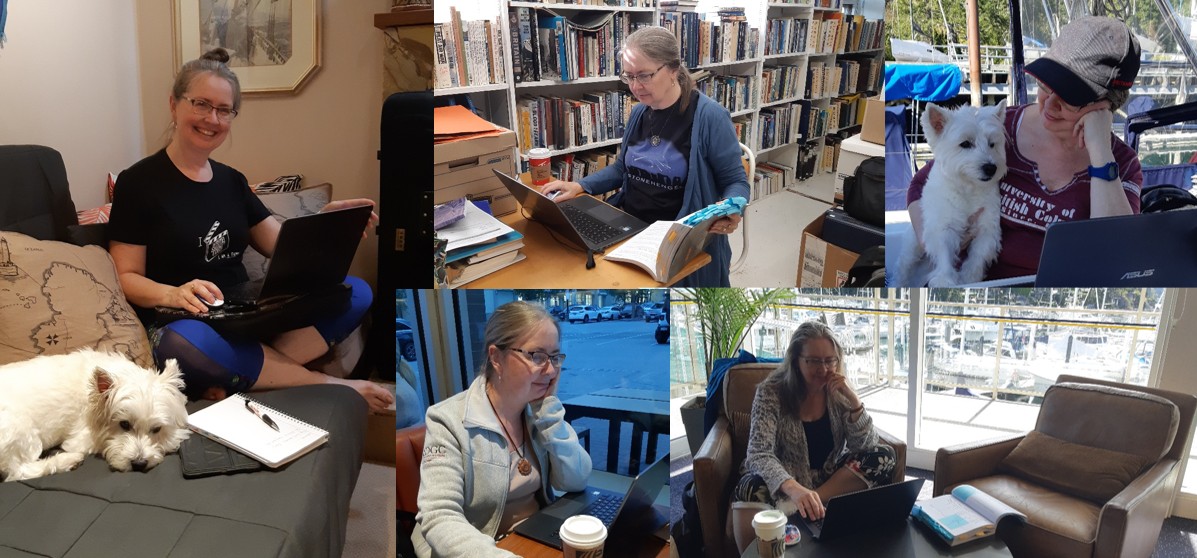
Deb writing in various locales

How Long Does It Take To Write A Book (Part 2: Planning It)

Okay, it’s kinda strange for Part 2 of this post to be about the planning writing a book after having covered the actual sit-down writing process in Part 1. The reason is that you can easily spend all your time planning and never get to the stage of actual writing and the actual writing stage is essential… so I gave it to you first. But yes, you have to plan a book before writing it.

The planning and research stage is much more nebulous and open-ended.

For nonfiction, you draft out a detailed table of contents – basically the outline and core of the book, you conduct research including reaching out to and interviewing subject matter experts, you write a couple of sample chapters to test out style and approach, you research other books on the market to see if what you’re writing is indeed original and marketable, and you research publishers (including self-publishing options) to find the right fit.

Here’s an overview of the time it took for the planning/research stage of the third edition of “Film Production Management 101”:

  • Winter/Spring 2023 – Research & planning, including revised Table of Contents, meeting Subject Matter Experts, researching the market.
  • Summer 2023 – Proposal to publisher for revised edition. Marking up the existing edition (optimistically getting ready for the writing stage). Continue Subject Matter Expert meetings.
  • Fall 2023 – Acceptance of proposal by publisher. Hands-on-keyboard writing stage of the whole book.
  • Winter 2024 – One month off break to reset the mind, then hands-on-keyboard writing of the final draft.
  • Spring 2024 – Delivery to publisher
  • Summer 2024 – Copyediting with the publisher
  • Christmas 2024 – First preview copy of published book
  • Winter 2025 – Publication of third edition of “Film Production Management 101”

… which is why when someone is asked how long it takes to write a book, they often say a year or more.

It’s also worthy of note (during the planning stage) that considering how long it takes to research, plan, write, rewrite and publish a book, it’s hugely important that the contents of the book will last. The material I started assembling back in winter/spring of 2023 needed to be topical as of publication in 2025 and needs to be relevant for many years to come.

I hope this post inspires and motivates you on your own writing journey in 2026. Best wishes to you in this new year of possibilities!

Cheers & a good writing session to you,
Deb

P.S. If you missed the “writing it” Part 1 post, here ‘tis:
https://www.debpatz.com/how-long-does-it-take-to-write-a-book-part-1-writing-it/

=====================

Film Production Management 101” (now in its third edition) is updated for today’s respectful workplace and sustainable practices – available worldwide, including Amazon-USA, Indigo-Canada and many other bookstores or directly from the publisher (MWP).

Write! Shoot! Edit!” (written for young adults) is a choose-your-own-path book where you can follow the path of the writer, director-DP or editor to make your first films. It’s also available worldwide, including Amazon-USA, Indigo-Canada (Kobo), or directly from the publisher (MWP).

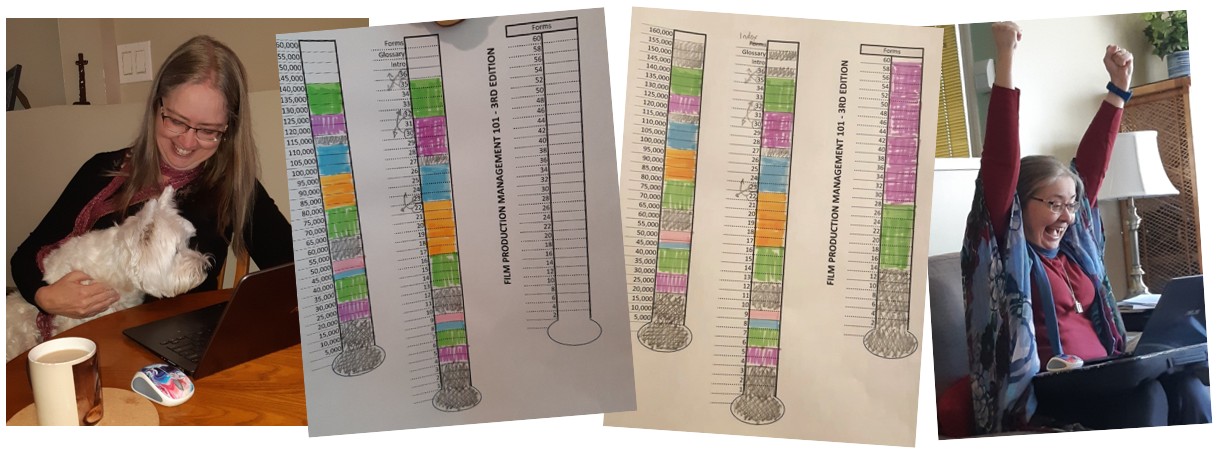
Deb and her writing thermometer

How Long Does It Take To Write A Book (Part 1: Writing It)

New Years brings to mind the setting of resolutions and taking steps toward fulfilling a life goal or two. Is writing a book one of those life goals you have? Many of us have a book (or many) in us itching to get out.

Having written a few books now myself, and with “Film Production Management 101” weighing in at over 500 pages, I’m frequently asked the question of how long it takes to write a book – especially while working full time. Well, let me tell you. My process is for a nonfiction book, but the approach and discipline can be adapted to any book or script.

Firstly, know that there is a whole stage of preparing to write the book, but I won’t go into the planning in this post. What we’re interested in is the actual sit-down and writing stage. I’ll cover planning in a Part-2 post.

So, planning is done. The table of contents (the outline) is set and you know what you’re going to cover in each chapter. In the case of “Film Production Management 101,” the table of contents already existed but was being modified for the third edition, as the new edition was undergoing a comprehensive rewrite from page 1.

I need both discipline and flexibility in the writing process. Although, once I start the fingers-to-keyboard writing phase, I need to keep pushing forward on a near daily basis. Some chapters are easier and faster to write than others, so getting bogged down in a one chapter for multiple days can be sobering if I don’t celebrate the days where I speed along.

For the initial edition, I pushed to average one chapter per writing day. I built in contingency days for family obligations and for the expectation that some chapters would take longer than 1 day (which several did). When I stopped midway on a hard chapter (at the end of a writing session), I’d spend the time before the next scheduled session mulling over the writing challenge that stopped me. Even if I didn’t think I’d solved whatever it was, I pushed forward anyway knowing I’d come back and rewrite this section at a future date. Overall, the plan was to write 22 chapters in 22 + 7 days (over 5 weeks) and in actuality, it took 7 weeks.

For the revised edition, I had a marked-up book to work from as inspiration for the rewrite. Some chapters needed less updating than others, so I’d push to rewrite multiple chapters a day based on how well the writing flow was, well, flowing. Those fast-flowing days helped me feel accomplished even when I got bogged down in a chapter challenging to craft. The writing days were a little less than for the initial edition (20 days for 35 chapters), but balancing work-life and writing stretched the overall writing period from the hoped-for 6 weeks to 12.

How, then, to celebrate and self-motivate? I make a visual tracker.

For the initial edition, I used a calendar and declared which writing day would be for which chapter. It made writing a whole book tangible, achievable. At the end of each writing session, I recorded the actual chapter / chapters / part-chapter that I did complete. As mentioned, I did miss the overall schedule by two weeks but that was negligible when you look at the whole work. The contingency days were critical for writing catch-up and to address family obligations. Mid-writing, I had the opportunity to re-plan how many writing sessions per chapter (rather than how many chapters per writing session), but the push to keep up the pace was working to motivate me so I kept the original schedule as-is and delivered to myself a little late.

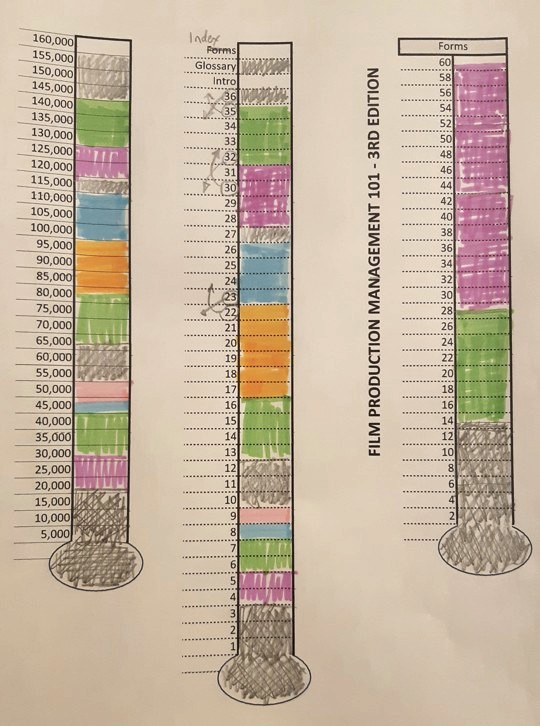
For the revised edition, I added colour to my tracker and turned it into a thermometer. I didn’t worry so much about meeting the minimum one chapter per day – the initial writing was already done (which takes longer) – so I used a writing thermometer which I posted on the fridge and I tracked both number of words and number of chapters I wrote in a day’s sitting. Because chapters varied in length, some days my word count was high, and other days my chapter count was high. I loved the messiness of random colours to keep my mind in a creative mindset. Here’s the completed thermometer tracker… where you’ll also see that I didn’t always write the chapters in order:
Thermometer writing schedule

Another nugget: I wrote the book at least twice each time. After the first pass writing the book (7 weeks for the initial edition, 12 weeks for the revised edition), I took a scheduled month off to let my mind reset enabling me to approach the book with fresh eyes. After the break, I leapt back in for a second pass rewrite. In the rewrite phase, I worked on concepts like accuracy, consistency of style, and overarching approach to the book. This phase of writing was much faster than the initial creation. I used a tracker for this phase too.

But as much as I love the writing – especially those magical easy-flow days – fitting in to a busy life is really, truly hard. The first time I wrote “Film Production Management” (which was called “Surviving Production” back then), I was single and working freelance – it was hard to write and hard fit into my life. When I wrote a later edition, I was married and had a dog and was working full time – and it was hard to write and hard fit into my life. When I wrote this latest edition, I was (still) married, had two dogs, a kid and an aging mother in the house – and it was hard to write and hard to fit into my life. But each time, I discovered: it was possible. Need outweighs the obstacles.

I hope this post gives you insight and inspiration for your own writing goals for 2026. Here’s to the new year and all its possibilities!

Cheers & a good writing session to you,
Deb

=====================

Film Production Management 101” (now in its third edition) is updated for today’s respectful workplace and sustainable practices – available worldwide, including Amazon-USA, Indigo-Canada and many other bookstores or directly from the publisher (MWP).

Write! Shoot! Edit!” (written for young adults) is a choose-your-own-path book where you can follow the path of the writer, director-DP or editor to make your first films. It’s also available worldwide, including Amazon-USA, Indigo-Canada (Kobo), or directly from the publisher (MWP).

Santa sleigh over sunrise

Sunrise in Space

Sunrises and sunset are magical: warm hues of pinks, oranges, reds wash the sky and paint the clouds at the start and end of each day for a good thirty minutes to hour or more, depending on your latitude. Sometimes the show is watery or pastel, sometimes the colours are vibrant. Sometimes we miss it for heavy cloud cover. Still, we know it’s there two times a day. No wonder it’s called “magic hour.”

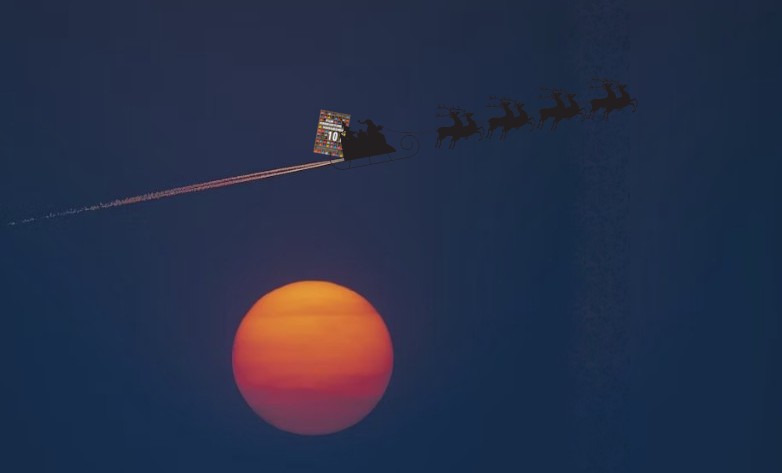
With the winter days growing shorter in the northern hemisphere, another season of magic is upon us – the festival season – and so the morning of December 25 has to be the most magical sunrise of the year. Nothing else could top that sunrise, could it?

Well… I was working with the IMAX space team and there was a day we brought some of the first 70mm footage back to Earth, including a sunrise in space. How cool could that be?!

Since we were based in Ontario, about 5 of us gathered at the IMAX theatre at Ontario Place for the first -look watch of the rushes. I couldn’t be more excited and felt humbly privileged to be there. I wondered what a sunrise in space would look like.

The frame started as pitch black. No image at all. With no ambient light in space, that made sense. And then…

It was over!

Yup. In four seconds, the frame went from full-frame black to everything brightly lit. Forget Earth latitude differences to the length of magic hour, there are no clouds in space and no atmosphere, so there’s nothing for sunrise to paint or to linger on. How disappointing, but also… of course! Like, duh!

And because of the orbit of the shuttle around the world, the astronauts would see one of these abrupt sunrises or sets every 90 minutes.

Wow. It makes you think. That’s a difference perspective to what we see here on the ground.

Admittedly, because of that “light-switch” sunrise, I probably appreciate the atmospheric art of magic hour on Earth more so now than ever, making magic hour even more special.

I hope you take time to enjoy the next one near you.

Cheers, a good shoot & magical season to you,
Deb

=====================

Film Production Management 101” (now in its third edition) is updated for today’s respectful workplace and sustainable practices – available worldwide, including Amazon-USA, Indigo-Canada and many other bookstores or directly from the publisher (MWP).

Write! Shoot! Edit!” (written for young adults) is a choose-your-own-path book where you can follow the path of the writer, director-DP or editor to make your first films. It’s also available worldwide, including Amazon-USA, Indigo-Canada (Kobo), or directly from the publisher (MWP).
Duck with tether, flying

CGI That Anachronism!

Hidden CGI is visual effects that are hidden in plain sight but are effectively invisible, not flashy. When you think of Hidden CGI, you probably first think about Forrest Gump, especially: the removal of Sargent Dan’s legs and the integrating of (fictional) Forrest into existing (real life) news footage to make the news clip suit the story of the film. This is Hidden CGI on a big and expensive scale.

On a small, shot-by-shot scale (which can also be costly), you may need CGI to remove unwanteds from the shot – stereotypically, to remove a boom that sneaks into frame, but it could also be:

  • The dog’s waggy tail while it’s growling (the dog may wag its tail in happiness of a job well done, but the tail is anachronistic – and distracting – to the mean growl)
  • Telephone poles or cell phone towers in country vista of a pre-electricity period piece
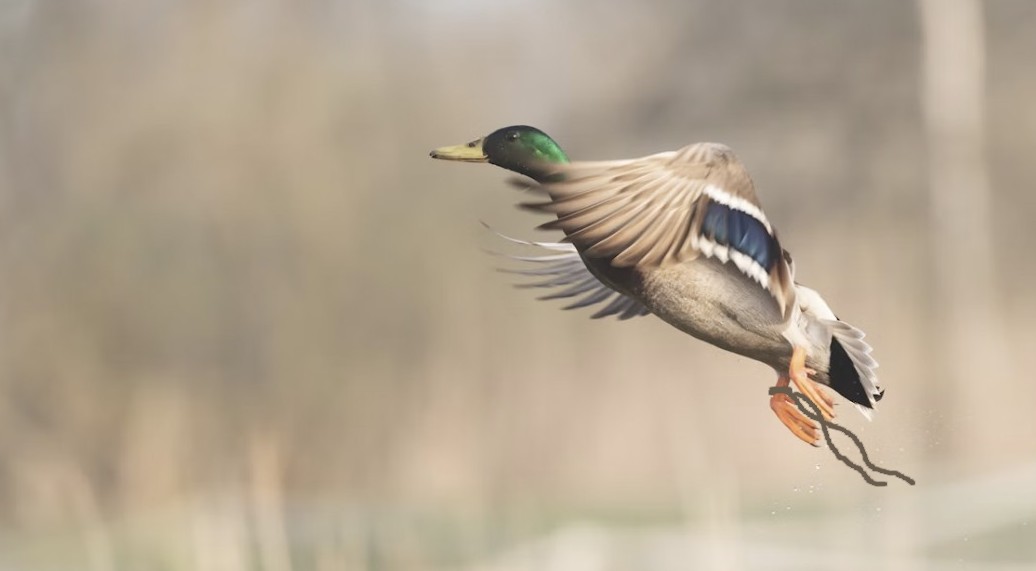
  • The tether on a flying, trained bird – the trainer may need it, but can’t remove it for the shot

If you don’t CGI the correction, the anachronism will distract and pull the audience out of the magic of the story, so have a read through your script.

Can you find Hidden CGI shots or potential ones in your script? Know early so you can plan during the shoot to minimize your need for CGI in post.

Cheers & a good shoot to you,
Deb

=====================

Film Production Management 101” (now in its third edition) is updated for today’s respectful workplace and sustainable practices – available worldwide, including Amazon-USA, Indigo-Canada and many other bookstores or directly from the publisher (MWP).
Write! Shoot! Edit!” (written for young adults) is a choose-your-own-path book where you can follow the path of the writer, director-DP or editor to make your first films. It’s also available worldwide, including Amazon-USA, Indigo-Canada (Kobo), or directly from the publisher (MWP).