0

Tag: writing life

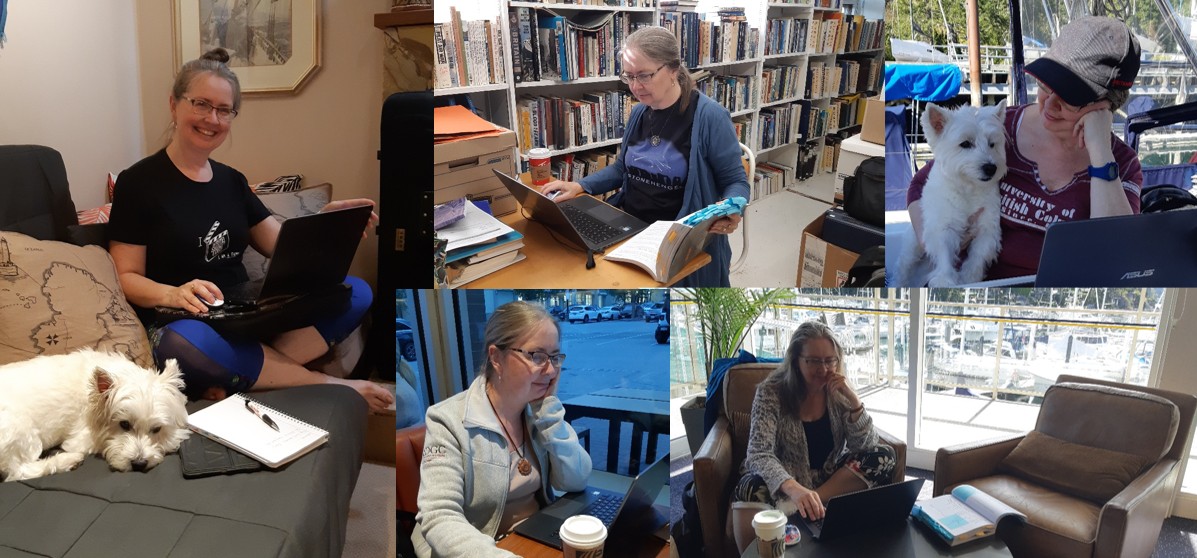
Deb writing in various locales

How Long Does It Take To Write A Book (Part 2: Planning It)

Okay, it’s kinda strange for Part 2 of this post to be about the planning writing a book after having covered the actual sit-down writing process in Part 1. The reason is that you can easily spend all your time planning and never get to the stage of actual writing and the actual writing stage is essential… so I gave it to you first. But yes, you have to plan a book before writing it.

The planning and research stage is much more nebulous and open-ended.

For nonfiction, you draft out a detailed table of contents – basically the outline and core of the book, you conduct research including reaching out to and interviewing subject matter experts, you write a couple of sample chapters to test out style and approach, you research other books on the market to see if what you’re writing is indeed original and marketable, and you research publishers (including self-publishing options) to find the right fit.

Here’s an overview of the time it took for the planning/research stage of the third edition of “Film Production Management 101”:

  • Winter/Spring 2023 – Research & planning, including revised Table of Contents, meeting Subject Matter Experts, researching the market.
  • Summer 2023 – Proposal to publisher for revised edition. Marking up the existing edition (optimistically getting ready for the writing stage). Continue Subject Matter Expert meetings.
  • Fall 2023 – Acceptance of proposal by publisher. Hands-on-keyboard writing stage of the whole book.
  • Winter 2024 – One month off break to reset the mind, then hands-on-keyboard writing of the final draft.
  • Spring 2024 – Delivery to publisher
  • Summer 2024 – Copyediting with the publisher
  • Christmas 2024 – First preview copy of published book
  • Winter 2025 – Publication of third edition of “Film Production Management 101”

… which is why when someone is asked how long it takes to write a book, they often say a year or more.

It’s also worthy of note (during the planning stage) that considering how long it takes to research, plan, write, rewrite and publish a book, it’s hugely important that the contents of the book will last. The material I started assembling back in winter/spring of 2023 needed to be topical as of publication in 2025 and needs to be relevant for many years to come.

I hope this post inspires and motivates you on your own writing journey in 2026. Best wishes to you in this new year of possibilities!

Cheers & a good writing session to you,
Deb

P.S. If you missed the “writing it” Part 1 post, here ‘tis:
https://www.debpatz.com/how-long-does-it-take-to-write-a-book-part-1-writing-it/

=====================

Film Production Management 101” (now in its third edition) is updated for today’s respectful workplace and sustainable practices – available worldwide, including Amazon-USA, Indigo-Canada and many other bookstores or directly from the publisher (MWP).

Write! Shoot! Edit!” (written for young adults) is a choose-your-own-path book where you can follow the path of the writer, director-DP or editor to make your first films. It’s also available worldwide, including Amazon-USA, Indigo-Canada (Kobo), or directly from the publisher (MWP).
Deb and her writing thermometer

How Long Does It Take To Write A Book (Part 1: Writing It)

New Years brings to mind the setting of resolutions and taking steps toward fulfilling a life goal or two. Is writing a book one of those life goals you have? Many of us have a book (or many) in us itching to get out.

Having written a few books now myself, and with “Film Production Management 101” weighing in at over 500 pages, I’m frequently asked the question of how long it takes to write a book – especially while working full time. Well, let me tell you. My process is for a nonfiction book, but the approach and discipline can be adapted to any book or script.

Firstly, know that there is a whole stage of preparing to write the book, but I won’t go into the planning in this post. What we’re interested in is the actual sit-down and writing stage. I’ll cover planning in a Part-2 post.

So, planning is done. The table of contents (the outline) is set and you know what you’re going to cover in each chapter. In the case of “Film Production Management 101,” the table of contents already existed but was being modified for the third edition, as the new edition was undergoing a comprehensive rewrite from page 1.

I need both discipline and flexibility in the writing process. Although, once I start the fingers-to-keyboard writing phase, I need to keep pushing forward on a near daily basis. Some chapters are easier and faster to write than others, so getting bogged down in a one chapter for multiple days can be sobering if I don’t celebrate the days where I speed along.

For the initial edition, I pushed to average one chapter per writing day. I built in contingency days for family obligations and for the expectation that some chapters would take longer than 1 day (which several did). When I stopped midway on a hard chapter (at the end of a writing session), I’d spend the time before the next scheduled session mulling over the writing challenge that stopped me. Even if I didn’t think I’d solved whatever it was, I pushed forward anyway knowing I’d come back and rewrite this section at a future date. Overall, the plan was to write 22 chapters in 22 + 7 days (over 5 weeks) and in actuality, it took 7 weeks.

For the revised edition, I had a marked-up book to work from as inspiration for the rewrite. Some chapters needed less updating than others, so I’d push to rewrite multiple chapters a day based on how well the writing flow was, well, flowing. Those fast-flowing days helped me feel accomplished even when I got bogged down in a chapter challenging to craft. The writing days were a little less than for the initial edition (20 days for 35 chapters), but balancing work-life and writing stretched the overall writing period from the hoped-for 6 weeks to 12.

How, then, to celebrate and self-motivate? I make a visual tracker.

For the initial edition, I used a calendar and declared which writing day would be for which chapter. It made writing a whole book tangible, achievable. At the end of each writing session, I recorded the actual chapter / chapters / part-chapter that I did complete. As mentioned, I did miss the overall schedule by two weeks but that was negligible when you look at the whole work. The contingency days were critical for writing catch-up and to address family obligations. Mid-writing, I had the opportunity to re-plan how many writing sessions per chapter (rather than how many chapters per writing session), but the push to keep up the pace was working to motivate me so I kept the original schedule as-is and delivered to myself a little late.

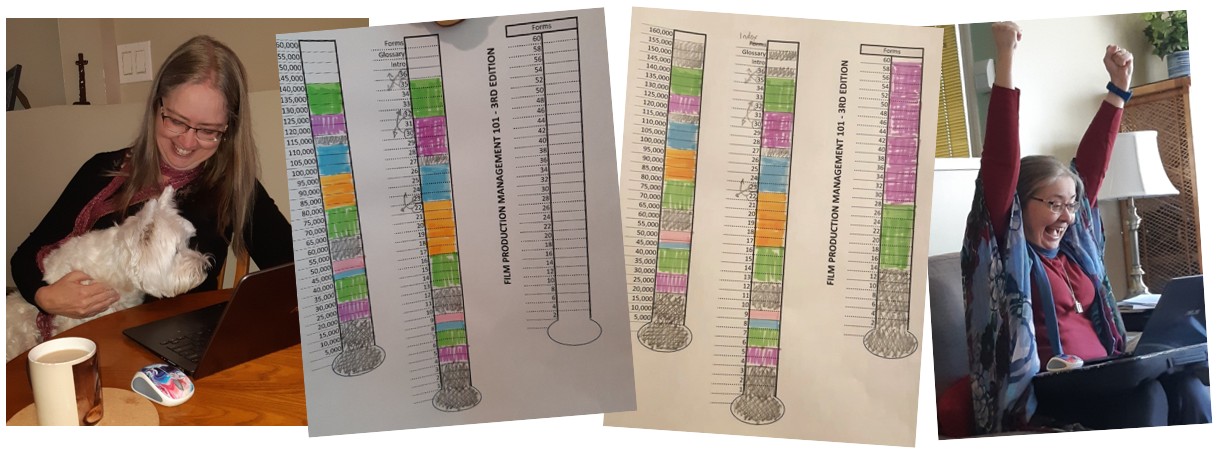
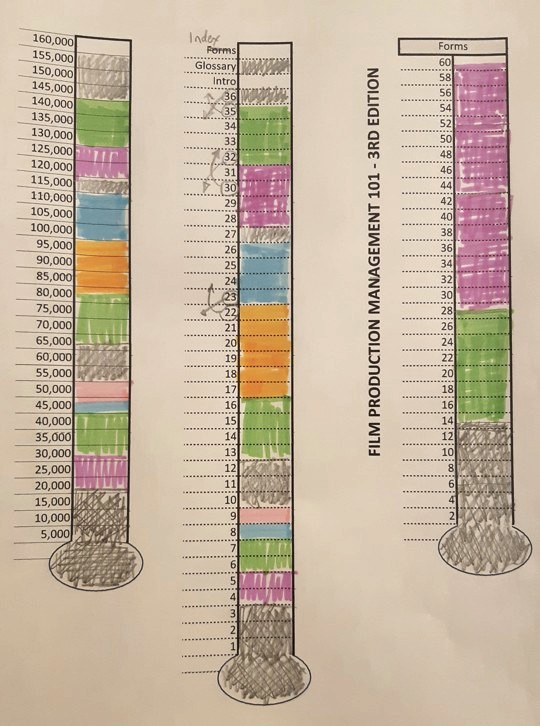
For the revised edition, I added colour to my tracker and turned it into a thermometer. I didn’t worry so much about meeting the minimum one chapter per day – the initial writing was already done (which takes longer) – so I used a writing thermometer which I posted on the fridge and I tracked both number of words and number of chapters I wrote in a day’s sitting. Because chapters varied in length, some days my word count was high, and other days my chapter count was high. I loved the messiness of random colours to keep my mind in a creative mindset. Here’s the completed thermometer tracker… where you’ll also see that I didn’t always write the chapters in order:

Thermometer writing schedule

Another nugget: I wrote the book at least twice each time. After the first pass writing the book (7 weeks for the initial edition, 12 weeks for the revised edition), I took a scheduled month off to let my mind reset enabling me to approach the book with fresh eyes. After the break, I leapt back in for a second pass rewrite. In the rewrite phase, I worked on concepts like accuracy, consistency of style, and overarching approach to the book. This phase of writing was much faster than the initial creation. I used a tracker for this phase too.

But as much as I love the writing – especially those magical easy-flow days – fitting in to a busy life is really, truly hard. The first time I wrote “Film Production Management” (which was called “Surviving Production” back then), I was single and working freelance – it was hard to write and hard fit into my life. When I wrote a later edition, I was married and had a dog and was working full time – and it was hard to write and hard fit into my life. When I wrote this latest edition, I was (still) married, had two dogs, a kid and an aging mother in the house – and it was hard to write and hard to fit into my life. But each time, I discovered: it was possible. Need outweighs the obstacles.

I hope this post gives you insight and inspiration for your own writing goals for 2026. Here’s to the new year and all its possibilities!

Cheers & a good writing session to you,
Deb

=====================

Film Production Management 101” (now in its third edition) is updated for today’s respectful workplace and sustainable practices – available worldwide, including Amazon-USA, Indigo-Canada and many other bookstores or directly from the publisher (MWP).

Write! Shoot! Edit!” (written for young adults) is a choose-your-own-path book where you can follow the path of the writer, director-DP or editor to make your first films. It’s also available worldwide, including Amazon-USA, Indigo-Canada (Kobo), or directly from the publisher (MWP).

Deb's FILM & INK Tips & Tales

Deb’s FILM & INK Newsletter… come ‘n join!

I’m back online (finally!) and bring with me a bit of news:

My FILM & INK blog has been converted and expanded into a FILM & INK Tips & Tales Newsletter. Come and enjoy some film production stories and nuggets of advice for working professionals and for teens just starting out:

Deb’s FILM & INK Tips & Tales Newsletter
https://mailchi.mp/00970e39a325/debpatzfilmandink

Like the blog, the newsletter complements my books, Film Production Management 101 (for managers and coordinators) and Write! Shoot! Edit! (for teens). With your input, I plan to tweak the newsletter as needed so it addresses your needs, educates, entertains and celebrates your successes.

Come and join FILM & INK! I look forward to connecting with you there! In the meantime, here’s the “Call Sheet Joke” from the inaugural issue:

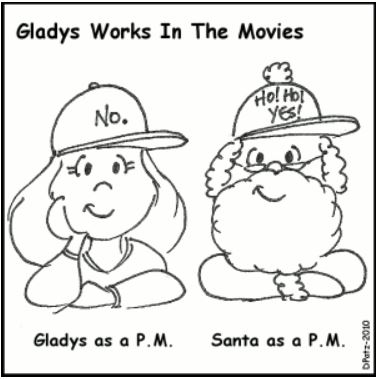
Gladys and Santa as PMs

Cheers & a good shoot to you,
Deb

– – – – – – – – – –

Deborah (Deb) Patz is the author of Write! Shoot! Edit! for teens and Film Production Management 101 for the industry – both books are published worldwide by MWP. She’s also part of the editorial board for Prism International and is new to figuring out this newsletter thing, but believes in lifelong learning… so that’s a good thing!

WHERE IS DEB? (upcoming events and appearances)
Feb. 1, 2020 – DM Youth Expo – North Vancouver, BC
Feb. 19, 2020 – I Read Canadian Day (more info to come)
July 26-30, 2020 – UFVA (University Film & Video Association) Conference, Tallahassee, FL

WHERE TO FIND DEB’S BOOKS?
Paperback or eBook: AmazonBarnes & Noble, Chapters/Indigo, direct from the publisher (MWP) and from plenty of other great bookstores worldwide.

How The Creative Brain Works: Two Perspectives

I read an interesting article in the May 2017 issue of National Geographic about how the brain works regarding creativity. As a people, we’ve tried to understand creativity for years. Can’t see it, can’t touch it, but it – whatever “it” is – is definitely there.

Nat Geo reports another scientific attempt to understand the creative process.

Researchers managed to record brain waves in an MRI while jazz musicians played music that was memorized and then music that was improvised. They learned that for the improv, the brain activity was “fundamentally different” and that it appeared the brain was able to turn off its own ability to criticize itself.

I find this fascinating because, I’ve learned the same thing from leading a creative life, and share as much in my new teen filmmaking book (“Write! Shoot! Edit!”) coming out this July. I believe it’s important to understand the creative process so you can better harness your creativity.

Though it appears the researchers break the creative process into two types of activities (in this case playing improv vs playing memorized music), through my experience, I believe the creative process breaks down into three stages:

(1) wild invention (the improv, free-creative activity)

(2) structural edit (a big picture activity where you work with historical conventions)

(3) nit-picky edit (a fine-tuning activity where details and consistency matters)

Each one of these stages needs its time at centre stage, its time of focus, so if it’s a writing project, you’ll have to write the project at least three times to focus your brain’s perspective for each draft.

I’d love to see an MRI scan of differing brain activity for each of these three phases of the creative process, as I believe each one taps into a different skills in the brain… but I guess we’ll have to wait for science to explore that idea someday.

For those living the creative life, what’s your perspective on the activity happening in your brain while you’re creating?

All the best of creativity to you,
Deb

For more info on my new book “Write! Shoot! Edit!” see my website’s book page.

– – – – – – – – – –

Deb Patz is the author of “Film Production Management 101” and the upcoming “Write! Shoot! Edit! A Complete Guide to Filmmaking for Teens” both published by MWP Books. She’s lived a creative life for… uh… all her life!

WHERE IS DEB? (upcoming events and appearances)
Jun.3-7 – Guest instructor – PEI Screenwriter’s Bootcamp, Charlottetown, PEI
Jun.24 – Book launch party for “Write! Shoot! Edit!” at Chapters Pinetree, Coquitlam, BC
Jul.30-Aug.3 – UFVA Conference, Los Angeles, CA