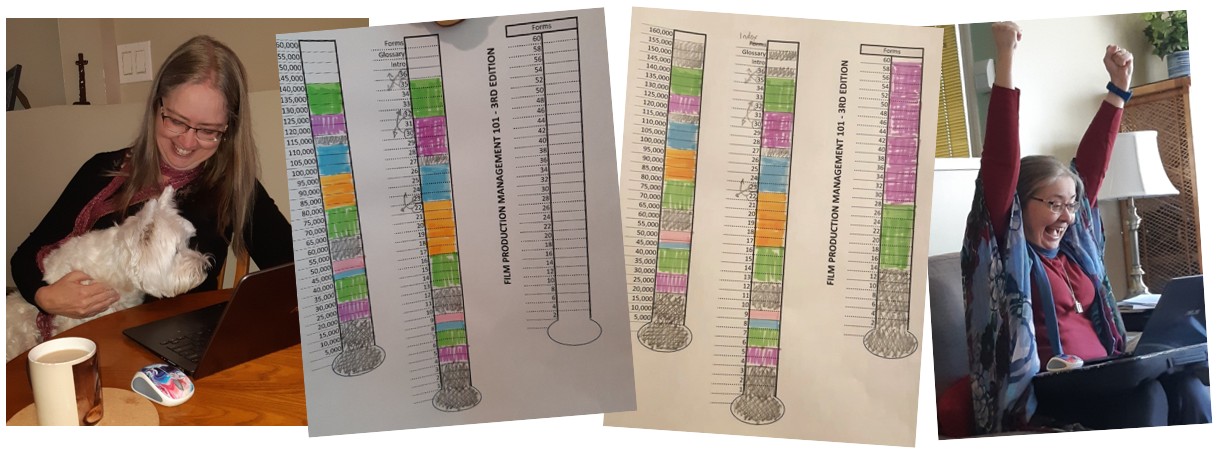
New Years brings to mind the setting of resolutions and taking steps toward fulfilling a life goal or two. Is writing a book one of those life goals you have? Many of us have a book (or many) in us itching to get out.
Having written a few books now myself, and with “Film Production Management 101” weighing in at over 500 pages, I’m frequently asked the question of how long it takes to write a book – especially while working full time. Well, let me tell you. My process is for a nonfiction book, but the approach and discipline can be adapted to any book or script.
Firstly, know that there is a whole stage of preparing to write the book, but I won’t go into the planning in this post. What we’re interested in is the actual sit-down and writing stage. I’ll cover planning in a Part-2 post.
So, planning is done. The table of contents (the outline) is set and you know what you’re going to cover in each chapter. In the case of “Film Production Management 101,” the table of contents already existed but was being modified for the third edition, as the new edition was undergoing a comprehensive rewrite from page 1.
I need both discipline and flexibility in the writing process. Although, once I start the fingers-to-keyboard writing phase, I need to keep pushing forward on a near daily basis. Some chapters are easier and faster to write than others, so getting bogged down in a one chapter for multiple days can be sobering if I don’t celebrate the days where I speed along.
For the initial edition, I pushed to average one chapter per writing day. I built in contingency days for family obligations and for the expectation that some chapters would take longer than 1 day (which several did). When I stopped midway on a hard chapter (at the end of a writing session), I’d spend the time before the next scheduled session mulling over the writing challenge that stopped me. Even if I didn’t think I’d solved whatever it was, I pushed forward anyway knowing I’d come back and rewrite this section at a future date. Overall, the plan was to write 22 chapters in 22 + 7 days (over 5 weeks) and in actuality, it took 7 weeks.
For the revised edition, I had a marked-up book to work from as inspiration for the rewrite. Some chapters needed less updating than others, so I’d push to rewrite multiple chapters a day based on how well the writing flow was, well, flowing. Those fast-flowing days helped me feel accomplished even when I got bogged down in a chapter challenging to craft. The writing days were a little less than for the initial edition (20 days for 35 chapters), but balancing work-life and writing stretched the overall writing period from the hoped-for 6 weeks to 12.
How, then, to celebrate and self-motivate? I make a visual tracker.
For the initial edition, I used a calendar and declared which writing day would be for which chapter. It made writing a whole book tangible, achievable. At the end of each writing session, I recorded the actual chapter / chapters / part-chapter that I did complete. As mentioned, I did miss the overall schedule by two weeks but that was negligible when you look at the whole work. The contingency days were critical for writing catch-up and to address family obligations. Mid-writing, I had the opportunity to re-plan how many writing sessions per chapter (rather than how many chapters per writing session), but the push to keep up the pace was working to motivate me so I kept the original schedule as-is and delivered to myself a little late.
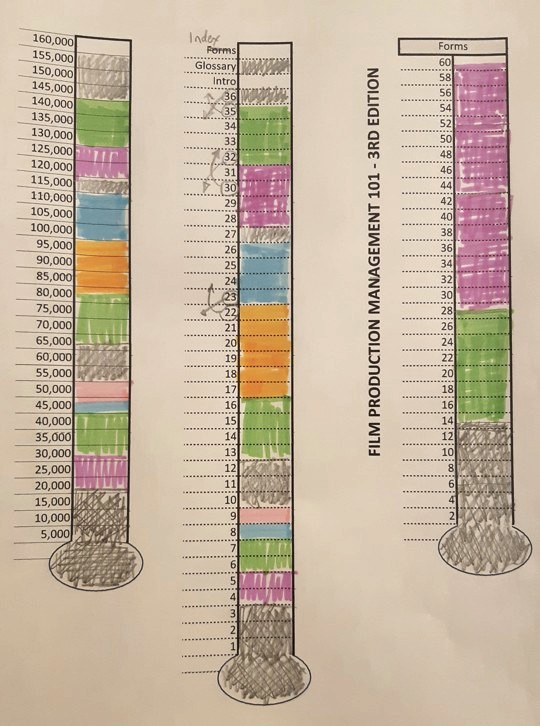
For the revised edition, I added colour to my tracker and turned it into a thermometer. I didn’t worry so much about meeting the minimum one chapter per day – the initial writing was already done (which takes longer) – so I used a writing thermometer which I posted on the fridge and I tracked both number of words and number of chapters I wrote in a day’s sitting. Because chapters varied in length, some days my word count was high, and other days my chapter count was high. I loved the messiness of random colours to keep my mind in a creative mindset. Here’s the completed thermometer tracker… where you’ll also see that I didn’t always write the chapters in order:
Another nugget: I wrote the book at least twice each time. After the first pass writing the book (7 weeks for the initial edition, 12 weeks for the revised edition), I took a scheduled month off to let my mind reset enabling me to approach the book with fresh eyes. After the break, I leapt back in for a second pass rewrite. In the rewrite phase, I worked on concepts like accuracy, consistency of style, and overarching approach to the book. This phase of writing was much faster than the initial creation. I used a tracker for this phase too.
But as much as I love the writing – especially those magical easy-flow days – fitting in to a busy life is really, truly hard. The first time I wrote “Film Production Management” (which was called “Surviving Production” back then), I was single and working freelance – it was hard to write and hard fit into my life. When I wrote a later edition, I was married and had a dog and was working full time – and it was hard to write and hard fit into my life. When I wrote this latest edition, I was (still) married, had two dogs, a kid and an aging mother in the house – and it was hard to write and hard to fit into my life. But each time, I discovered: it was possible. Need outweighs the obstacles.
I hope this post gives you insight and inspiration for your own writing goals for 2026. Here’s to the new year and all its possibilities!
Cheers & a good writing session to you,
Deb
=====================
“Film Production Management 101” (now in its third edition) is updated for today’s respectful workplace and sustainable practices – available worldwide, including Amazon-USA, Indigo-Canada and many other bookstores or directly from the publisher (MWP).
“Write! Shoot! Edit!” (written for young adults) is a choose-your-own-path book where you can follow the path of the writer, director-DP or editor to make your first films. It’s also available worldwide, including Amazon-USA, Indigo-Canada (Kobo), or directly from the publisher (MWP).
Pingback:How Long Does It Take To Write A Book (Part 2: Planning It) – Deborah S. Patz – Author